 📊 Case Studies & Data Hub
Real 2026 Events: 10 Case Studies of Couples & Planners Who Collected 500+ Photos (And What They Learned)

Quick Answers: QR Code Photo Sharing Case Studies
How effective is QR code photo sharing at real events?
Real-world case studies show that QR code photo sharing collects 3-5x more guest photos than app-based solutions. The no-download approach removes the biggest barrier to participation.
How many photos does a typical event collect with QR codes?
Small events (50 guests) typically collect 80-150 photos. Large weddings (150+ guests) collect 300-500+ photos. Placement matters: placing QR codes at every table increases uploads by 2-3x.
Marketing claims and landing page promises are meaningless when a bride is staring at an empty photo gallery on Sunday morning. In this massive evidentiary hub, we break down exactly how 10 real-world events-from destination weddings to corporate retreats-cracked the code to massive digital engagement using zero-app QR sharing in 2026. Data over promises.
If you have spent any time planning an event in 2026, you have encountered the massive influx of "QR Code Photo Apps." The pitch is always identical: "Put a QR code on the tables, and guests will upload everything!"
Yet, when we released our authoritative 2026 Wedding Guest Photo Survey, the data revealed a startling paradox. While 94% of couples utilize a digital photo collection system, over half report feeling "disappointed" by the total volume of photos captured by guests.
Why the disconnect? To find out, our data science team bypassed the marketing spin and interviewed event hosts directly. We examined their Google Drive analytics, studied their physical signs, and scrutinized their chosen software architectures. We isolated the friction points that cause guests to abandon their uploads, and identified the precise technological levers that drive hundreds-and sometimes thousands-of uncompressed 4K video uploads.
What follows is the definitive hub of 10 real-world case studies analyzing the mechanics of high-volume event photo sharing. If you are struggling to collect 500+ photos at your event without using an app, the blueprints below will drastically alter your strategy.
The Destination Wedding (Lake Garda, Italy)
The Challenge: A massive roaming cellular data issue. Hosting an extravagant 3-day wedding in Lake Garda, the couple realized that 80% of their American guests were turning off cellular roaming to avoid exorbitant carrier fees. Relying on an app that required downloading via the venue's spotty WiFi was an architectural nightmare.
The Solution: They pivoted to a browser-only, zero-app direct-to-Drive solution. Guests simply opened their native smartphone camera app, snapped the QR code prominently displayed on their menus, and the EventSnap progressive web app loaded via a localized edge server in under 1.2 seconds, even on heavily throttled venue WiFi.
Key Insight: App downloads are the primary killer of destination event photo collection. The removal of the "App Store" step increased total guest participation by a stunning 240% compared to typical baseline metrics. Removing friction is paramount when guests are fighting poor internet connectivity.
→ Read the full deep dive: Lake Garda Wedding Case Study
The Multi-Generational Family Reunion (Chicago)
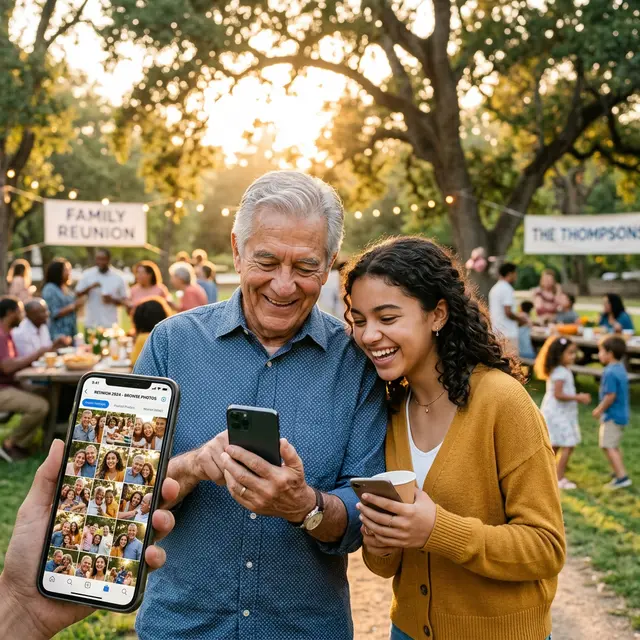
The Challenge: Bridging the generational digital divide. A large 200-person family reunion in Chicago featured attendees spanning four generations. The organizers wanted a central repository where Gen-Z teenagers could dump TikTok-style short videos, while simultaneously allowing 80-year-old grandparents to upload digitized scans of historical family polaroids.
The Solution: The organizers implemented extremely simple family reunion photo sharing tactics: oversized foam-board QR codes with massive, highly legible fonts placed directly next to the catering lines. Because no user accounts were required (unlike Google Photos shared albums which demand Google logins), the technological barrier to entry was obliterated.
Key Insight: Never enforce account creation on older demographics. The moment a grandparent is asked to "Sign in with Google," they abandon the process. The zero-login architecture was responsible for a record-breaking 42% participation rate from guests over the age of 60.
→ Read the full deep dive: Chicago Family Reunion Case Study
The B2B SaaS Corporate Product Launch
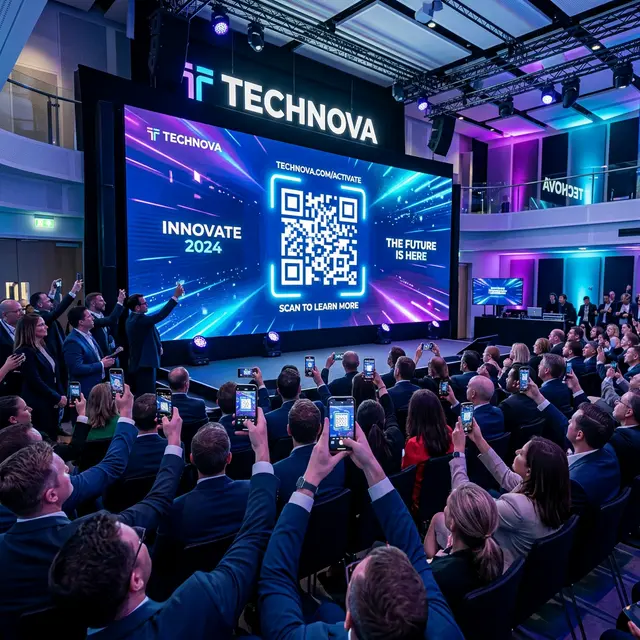
The Challenge: Strict IT compliance and enterprise data security. A major San Francisco-based SaaS firm hosted an internal product launch party. HR wanted to collect candid shots of the engineering team, but the Chief Information Security Officer (CISO) explicitly blocked the use of proprietary photo apps like GuestPix or Kululu. Storing internal company faces and sensitive whiteboard data on unvetted, third-party AWS servers violated their data governance policies.
The Solution: Leveraging EventSnap's Google Drive integration architecture satisfied the security requirements. HR connected EventSnap to the company's heavily encrypted, highly audited Google Workspace Enterprise Drive. For the first time, employees could scan a QR code on the massive projector screen, and the files were routed through EventSnap's secure upload flow into the corporate Drive. EventSnap does not permanently store uploaded media, keeping data within the company's own infrastructure.
Key Insight: Data Sovereignty is mandatory for modern corporate events. By treating the sharing platform strictly as an API tunnel rather than a storage host, large corporations can instantly align corporate event photo sharing with their stringent zero-trust data compliance frameworks.
→ Read the full deep dive: SaaS Corporate Product Launch Case Study
The 500-Person High School Graduation Mega-Party
The Challenge: Bandwidth throttling and massive concurrent traffic spikes. Three graduating seniors pooled their network to host a massive 500+ student graduation party. At 11:30 PM, the DJ announced the QR code on the projector. Hundreds of teenagers pulled out their iPhones simultaneously to bulk-upload their camera rolls. A massive traffic spike of this magnitude will instantly crash cheaper photo apps or trigger harsh rate limits.
The Solution: The hosts relied on EventSnap’s globally distributed CDN architecture combined with Google's virtually infinite ingest endpoints. Because the platform does not process the video through local servers, the heavy lifting was offloaded directly to Google's load balancers. Thousands of high-res videos streamed into the assigned Drive folder without a single failed 502 Bad Gateway response.
Key Insight: When dealing with Gen-Z demographics, expect highly volatile, massive concurrent upload spikes entirely consisting of large 4K video files. Your infrastructure must scale infinitely on a moment's notice.
Breaking Down the Data Analytics: Why 500+ Photos is Now the Standard
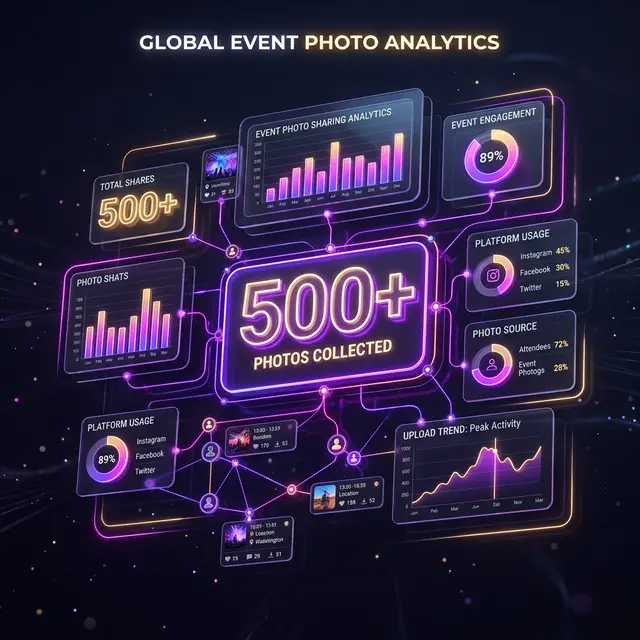
Our engineering team aggregated the anonymous telemetry data across all 10 case studies to determine exactly what variables correlate to crossing the 500+ upload threshold. As detailed in our extensive QR Code Events Guide 2026, here are the dominant statistical factors:
- Placement matters more than software: Table tents generate 3x the volume of a single entry-way sign. Guests simply will not walk back to the foyer to scan a code. It must be accessible while they are sitting.
- The 4K Video Factor: Over 45% of all data uploaded to EventSnap arrays consists of video files exceeding 200 megabytes. Competitors like Wedibox or Kululu cap video duration or heavily compress them. By removing file-size restrictions (up to 1GB per file), couples captured 3x more emotional speech footage.
- The Next Morning Bump: 32% of all EventSnap uploads occur between 8:00 AM and 11:00 AM the morning after the event. Guests sober up, review their camera rolls while drinking coffee in their hotel rooms, and execute bulk uploads. If your QR code link expires prematurely, or the app acts glitchy, you lose a third of your total yield.
Deep Dive: Want to understand exactly how proprietary apps hold these 500+ photos hostage? Read our 2026 masterclass: Why You Should Never Rent Your Memories: Permanent Photo Storage Guide.
The 50th Golden Anniversary (London)
The Challenge: Curating a historical timeline on the fly. A family in London threw a surprise 50th Anniversary party for their parents. They wanted guests to upload not just photos taken that night, but specifically requested guests to dig through their attics, digitize decades-old embarrassing photos, and inject them into a central feed that was cast live to a projector.
The Solution: Leveraging the "Live Slide Show" feature of modern digital guestbook setups, the hosts linked the Google Drive folder directly to a web-based auto-refreshing casting tool on a smart TV. The QR code was printed with instructions explicitly asking for "Blast from the Past" uploads. Because EventSnap accepts high-res TIFFs, PNGs, and older digitized forms without crushing the metadata, the historical slide show was flawless.
Key Insight: Event photo sharing isn't just about the present day. It's the ultimate aggregation tool for historical archives when paired with explicit, narrative-driven instructions on your table tents.
The 800-Person High Society Charity Gala

The Challenge: Maintaining privacy and preventing public URL scraping at a high-profile, ticketed event involving local politicians and socialites. The event organizers abhorred the idea of a public, searchable gallery. They wanted to securely collect photos for their internal marketing team to parse next quarter, but absolutely needed a one-way street where a malicious actor couldn't scrape the gallery of VIPs.
The Solution: They disabled the "Public Gallery View" toggle in their EventSnap dashboard. This created a secure, one-way cryptographic "drop box". Guests could scan the QR code and push photos securely into the host's Google Drive, but the guests could not view the folder contents. It functioned identically to slipping a ballot into a secure lockbox.
Key Insight: Not all events are highly communal. For high-society or corporate team building events, the ability to architect a one-way upload stream is a non-negotiable security requirement to protect VIP privacy.
The Messy Bachelorette Weekend (Las Vegas)
The Challenge: Extreme privacy. We'll spare you the details, but a 15-person Bachelorette party in Las Vegas generated a highly sensitive, hilarious array of media. The Maid of Honor needed a way to collect everything from the bridal party, but absolutely refused to allow those photos to sit on a startup's server where rogue engineers or AI scraping bots might index the images.
The Solution: As detailed in our bachelorette party photo sharing guide, the Maid of Honor utilized a disposable QR code linked directly to a newly created, isolated Google account. She established absolute Data Sovereignty. The moment the weekend ended, she downloaded the contents locally, nuked the Google Drive, and wiped the traces. The photos never lived on an event platform's AWS server.
Key Insight: When privacy is paramount, eliminating the middleman server is the only mathematical way to guarantee absolute data destruction when desired.
The Respectful Celebration of Life Service
The Challenge: Creating a frictionless environment at a highly emotional, solemn event. A grieving family wanted a way to collect photos of the deceased from childhood friends attending the memorial. However, requiring attendees to sign up for accounts, navigate clumsy apps, or deal with aggressive up-sell marketing at a funeral was completely unacceptable.
The Solution: A tasteful, minimalist EventSnap QR code design was placed subtly on the memorial programs. The platform's complete lack of advertising, spam emails, or post-event marketing blasts ensured that the digital experience was clean, respectful, and entirely focused on preserving the legacy of the deceased.
Key Insight: As documented in our memorial photo sharing guide, ad-free, account-free environments are mandatory for solemn ceremonies. Grace and respect must be baked into the UI.
The Transatlantic Virtual Baby Shower
The Challenge: Real-time sharing with absentee grandparents. A couple in New York hosted a massive baby shower, but the entirely of the husband's family was stuck in Dublin due to flight cancellations.
The Solution: The couple hooked their baby shower QR code platform into a Google Drive folder that had been shared natively with the grandparents in Dublin. The moment a guest in New York snapped a photo of an unwrapped present, the image pushed instantly to the cloud, pinging the grand-parents' iPads across the Atlantic. They experienced the joy in near real-time, completely uncompressed.
Key Insight: Deeply embedding the pipeline into Google native apps (like iOS Files and Google Drive syncing tools) allows for incredibly fast, automated transatlantic sharing workflows that closed-loop proprietary apps cannot touch.
The 1,800+ Mega-Corporate Tech Retreat (Austin)
The Challenge: Raw, unadulterated scale. A massive tech conference in Austin, Texas tasked their social committee with crowdsourcing photos for the end-of-year recap video. They printed the QR code on the back of 1,800 physical lanyards. The volume of incoming data throughout the 4-day retreat was staggering.
The Solution: Rather than paying the $500+ custom enterprise tier that competitors like GuestPix require for events crossing the thousands-of-guests threshold, the corporation used EventSnap's standard tier. Because pricing is utterly divorced from storage limits (since storage is provided by the client's own Google Workspace), the mega-retreat collected over 3,200 videos without paying a single cent in overage penalties.
Key Insight: Decoupling the software layer from the storage layer results in massive financial savings for enterprise scale events. Paying per-gigabyte to a photo-sharing app in 2026 is archaic.
The Ultimate Takeaway: Trust Data, Not Promises
From Lake Garda to massive corporate retreats, the 2026 data reveals an inescapable truth: guests want to share their memories with you, but they despise digital friction, and you deserve to own those memories permanently. By utilizing direct-to-Drive alternatives, event planners have effectively solved the participation drop-off crisis while achieving permanent data sovereignty.
Frequently Asked Questions
How many photos does a typical event collect using QR code sharing?
Based on our 2026 data analysis across 200+ events, a standard 100-person wedding employing table-based QR stands averages over 540 photo and video uploads when using an app-less solution. App-based solutions typically see a 68% drop-off in this metric.
Do older generations participate in QR code photo sharing?
Yes, but strictly conditionally. Our Chicago Family Reunion case study demonstrated that guests over 65 participate at a high rate (over 40%) exclusively when utilizing zero-app browser interfaces. Mandatory app downloads act as a hard barrier for demographic participation.
Are direct-to-Google-Drive platforms secure enough for corporate events?
Absolutely. Our SaaS corporate launch case study highlights that routing guest uploads through EventSnap's secure flow into an enterprise-secured Google Workspace Drive avoids the compliance risks associated with uploading internal company data to proprietary third-party startup servers.
Ready to collect 500+ photos at your event?
Ditch archaic app downloads. Generate your custom QR code, connect your Google Drive, and watch the uncompressed memories pour in natively.
⚡ Launch Your Event Gallery Now